
Dance Lexicon
Short descriptions of the history, music and steps of many dance styles. The written information is free to be used by dancers, in any format.
We divided the dances into 4 categories (click for more information):
Please note that all the International and Latin 'Night Club' dances could be danced as Social, Competitive, or showcase. Furthermore, we do not refer to the American style, since we do not deal with any local style. The International style is used worldwide, and will be the style used in the Olympics in the future.
Table terms:
General terms:
- Music beat
- The core 'rhythm atom' of the music. For example, the 1 or 2 or 3 in a Waltz.
- Music bar
- A whole beat structure. For example 1, 2, 3 in Waltz is one bar.
- Tempo
- The speed of the music.
- Bars per minute
- The tempo measured by counting the number of bars per minute.
- Beats per minute
- The tempo measured by counting the number of beats per minute. Note: If one wants to calculate the beats per minute, the calculation is simple – Beats per Minute = (Bars per minute) x (the number of the beats in one bar). For example, in English Waltz there are 30 bars per minute and 3 beats to a bar. Therefore the tempo is 30 bars per minute or 180 beats per minute.
- Syncopation
- Music beat in between the core beats. It could be referred to as '&' or 'a' when counting. For example: 4 & 1, which is used in Cha Cha Cha.
- Emphasis (in music)
- The strongest beat. For example, the 1 in Cha Cha Cha or 4 in Rumba.
- Pelvis Action
- Any separated/isolated motion of the pelvis. This action could be a side shift, a relaxation of the hip, rotation, contraction and release, a figure eight, a pressure step with rotation, and more.
- Swing
- An action related to a shift of weight combined with a pelvis action. Latin dances contain swing actions.
- Sway
- An action related to a shift of the whole body, usually stretching one side. The Sway is used in English Waltz, Viennese Waltz, Foxtrot and Quickstep.
International Latin Dances
The Latin dances have a strong connection between the strong beat of the music and the pelvis actions. This creates a synergy with the typical pelvis separation of all Latin dances. For example: In Cha Cha Cha the strong beat is 1, which leads to a strong pelvis action to the right or left. In Rumba it is the 4th beat, which leads to a relaxation of the hips, thus creating a 'curvy' look.
The Latin dances are divided into two categories: Progressive (Samba and Paso Doble) and Stationary (Cha Cha Cha, Rumba and Jive). The hold is an open one, meaning there is no body contact except for the shoulder, arm, and hands.
Cha Cha ChaListen
Originally a Cuban dance that developed out of the Mambo, it was first called 'Triple Mambo,' meaning, the mambo plus three steps. The three extra steps were entitled 'cha cha cha' and are syncopated on beats 1 and 4. The dance expresses happiness and mischievousness, and contains elements of reciprocated seduction. The music contains a rich rhythm, marked with percussion instruments. The emphasized hip movements in this dance are a direct effect of the leg work.
Basic Step:
| Step # | Count | Man's step | Lady's step | Notes |
|---|---|---|---|---|
| 1 | 2 | LF FWD | RF BWD | An 1/8 to a 1/4 turn CCW is optional |
| 2 | 3 | Weight back to RF | Weight back to LF | |
| 3 | 4 | LF to the left | RF to the right | |
| 4 | & | RF almost closing | LF almost closing | |
| 5 | 1 | LF to the left | RF to the right | |
| 6 | 2 | RF BWD | LF FWD | An 1/8 to a 1/4 turn CCW is optional |
| 7 | 3 | Weight back to LF | Weight back to RF | |
| 8 | 4 | RF to the right | LF to the left | |
| 9 | & | LF almost closing | RF almost closing | |
| 10 | 1 | RF to the right | LF to the left |
RumbaListen
A Cuban love dance, this dance forms the basis for many other Latin dances. The dance incorporates hip, waist and pelvis movements that express sensuality (especially by the lady), and contains elements of seduction and love. The music is relatively slow and allows much room for self-expression and individual style.
Basic Step:
| Step # | Count | Man's step | Lady's step | Notes |
|---|---|---|---|---|
| 1 | 2 | LF FWD | RF BWD | An 1/8 to a 1/4 turn CCW is optional |
| 2 | 3 | Weight back to RF | Weight back to LF | |
| 3 | 4 | LF to the left | RF to the right | |
| 4 | 1 | Left hip relaxes | Right hip relaxes | |
| 5 | 2 | RF BWD | LF FWD | An 1/8 to a 1/4 turn CCW is optional |
| 6 | 3 | Weight back to LF | Weight back to RF | |
| 7 | 4 | RF to the right | LF to the left | |
| 8 | 1 | Right hip relaxes | Left hip relaxes |
SambaListen
The samba originated in Brazil, of course, but the modern Ballroom technique is utterly different from the carnival. The samba as a couples' dance is characterized by up and down, greatly energetic movements that match the rhythmic coursing music. The movement is composed both of steps that move forward and steps that don't, and is accompanied by bending and straightening knee movements ('Bounce Action').
Basic Step:
| Step # | Count | Man's step | Lady's step | Notes |
|---|---|---|---|---|
| 1 | 1 | RF FWD | LF BWD | |
| 2 | & | Close LF | Close RF | Bounce action |
| 3 | 2 | RF in place | LF in place | |
| 4 | 3 | LF BWD | RF FWD | |
| 5 | & | Close RF | Close LF | Bounce Action |
| 6 | 4 | LF in place | RF in place |
JiveListen
This is the most modern, inclusive and rich dance in the family of Rock and Roll dances. The movement is composed of eight steps instead of six, making the dance look lively and animated. The dance expresses gaiety, happiness and sometimes even mischievous play between the partners. There are a few systems of counting for jive; we use the method of counting eight steps in a bar and a half.
Basic Step:
| Step # | Count | Man's step | Lady's step | Notes |
|---|---|---|---|---|
| 1 | 1 | LF BWD | RF BWD | |
| 2 | 2 | Weight back to RF | Weight back to LF | |
| 3 | 3 | LF to the centre and slightly to left | RF to the centre and slightly to right | Pelvis stays |
| 4 | & | RF pushing to left | LF pushing to right | |
| 5 | 4 | LF to the left | RF to the right | Pelvis moves |
| 6 | 5 | RF to the centre and slightly to right | LF to the centre and slightly to left | Pelvis stays |
| 7 | & | LF pushing to right | RF pushing to left | |
| 8 | 6 | RF to the right | LF to the left | Pelvis moves |
PasodobleListen
This dance represents a Bull Fight – the man is the matador and the lady his airy cape. The dance originated in Spain and is somewhat reminiscent of Flamenco dancing. The name Paso Doble comes from the words for step (Paso) and double (Doble). The man's role is conspicuous in its leading and in the movements which suggest a bull fighter in the arena. At times the man stamps his right foot before going into the next step, just like the movements of a matador to arouse the bull. The role of the lady is to represent the matador's cape – to be light and to respond quickly and swiftly to the man's leading.
Basic Step:
| Step # | Count | Man's step | Lady's step | Notes |
|---|---|---|---|---|
| 1 | 1 | RF in place | LF in place | Steps could also be a march to the side or FWD / BWD |
| 2 | 2 | LF in place | RF in place | |
| 3 | 3 | RF in place | LF in place | |
| 4 | 4 | LF in place | RF in place |
International Standard Dances
The Standard dances got their name from the phrase 'Standard European Dances' because these dances were part of the curriculum in high schools in Europe for many years. Today they are also called 'Modern Ballroom Dances'.
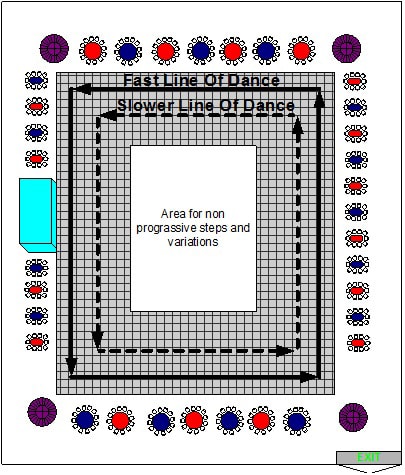
The standard dances incorporate a whole body motion. The hold is a closed hold that incorporates body contact at the right side of the upper part of the pelvis. In the Standards, there is no separation of lower and upper body (no 'pelvis actions'). All the Standards are progressive dances, danced on the line of dance (the perimeter of the dance floor), counter clockwise.
Note: It takes much longer to master the Standards, because they contain a lot of details necessary for dancing properly. It is like building an arch – it is solid only when the last stone is in place.
English WaltzListen
The English Waltz is also known as the slow waltz (mainly because it is half the speed of Viennese waltz). The steps are large, with a downward emphasis on the first beat and an upward emphasis on two and three. This creates a rise and fall 'wavy' action, which is combined with a sway to create a beautiful flow. Just like in all standard dances, it is danced counterclockwise around the Line of dance. The couple can complete 3/4 of a turn every 2 bars.
Basic Step:
| Step # | Count | Man's step | Lady's step | Notes |
|---|---|---|---|---|
| 1 | 1 | RF FWD | LF BWD | Start DW, 3/8 turn CW, End on LOD |
| 2 | 2 | LF to the side | RF to the side | |
| 3 | 3 | RF Close | LF Close | |
| 4 | 1 | LF BWD | RF FWD | 3/8 turn CW, End DC |
| 5 | 2 | RF to the side | LF to the side | |
| 6 | 3 | LF Close | RF Close | |
| 7 | 1 | RF FWD | LF FWD | Change, No turn |
| 8 | 2 | LF to the side | RF to the side | |
| 9 | 3 | RF Close | LF Close | |
| 10 | 1 | LF FWD | RF FWD | 3/8 turn CCW, End on LOD |
| 11 | 2 | RF to the side | LF to the side | |
| 12 | 3 | LF Close | RF Close | |
| 13 | 1 | RF BWD | LF FWD | 3/8 turn CCW, End DW |
| 14 | 2 | LF to the side | RF to the side | |
| 15 | 3 | RF Close | LF Close | |
| 16 | 1 | LF FWD | RF FWD | Change, No turn |
| 17 | 2 | RF to the side | LF to the side | |
| 18 | 3 | LF Close | RF Close | Back to Step #1 |
TangoListen
The tango known today is divided into two main styles, both in music and in technique: Modern tango and Argentinean tango. The tango originates in a dance called the Habanera (named after the city of Havana) which was imported by immigrants to Argentina around the year 1880. In Argentina the dance took on the features of sensual seduction and the club ambience of the time. The tango returned to Europe as a ballroom dance, with different music and technique but with its dramatic quality unaltered. In every form of tango the steps go by counts of 'slow' and 'quick,' knees slightly bent in order to stay at the same height and to allow catlike movements.
Basic Step:
| Step # | Count | Man's step | Lady's step | Notes |
|---|---|---|---|---|
| 1 | S | RF FWD | LF BWD | Steps could also be done in a curve around the LOD |
| 2 | S | LF FWD | RF BWD | |
| 3 | Q | RF FWD | LF BWD | |
| 4 | Q | LF FWD | RF BWD |
Viennese WaltzListen
The Viennese waltz is the oldest of the Standard ballroom dances. The Viennese waltz is always danced counterclockwise around the Line Of Dance. Couples are supposed to complete half a turn every music bar (1, 2, 3). Since a strict tempo Viennese Waltz is 60 bars per minute, the dancers are turning at a rate of 30 turns a minute; therefore, the waltz is danced right and left – 8 to 16 bars in each direction. The change of direction prevents dizziness even when dancing for a long time.
Basic Step:
| Step # | Count | Man's step | Lady's step | Notes |
|---|---|---|---|---|
| 1 | 1 | RF FWD | LF BWD | Start DC, 1/2 turn CW |
| 2 | 2 | LF to the side | RF to the side | |
| 3 | 3 | RF Close | LF Close | |
| 4 | 1 | LF BWD | RF FWD | 1/2 turn CW, End DC |
| 5 | 2 | RF to the side | LF to the side | |
| 6 | 3 | LF Close | RF Close | |
| 7 | 1 | RF FWD | LF FWD | Change, No turn |
| 8 | 2 | LF to the side | RF to the side | |
| 9 | 3 | RF Close | LF Close | |
| 10 | 1 | LF FWD | RF FWD | 1/2 turn CCW |
| 11 | 2 | RF to the side | LF to the side | |
| 12 | 3 | LF Close | RF Close | |
| 13 | 1 | RF BWD | LF FWD | 1/2 turn CCW, End DC |
| 14 | 2 | LF to the side | RF to the side | |
| 15 | 3 | RF Close | LF Close | |
| 16 | 1 | LF FWD | RF FWD | Change, No turn |
| 17 | 2 | RF to the side | LF to the side | |
| 18 | 3 | LF Close | RF Close | Back to Step #1 |
Slow FoxtrotListen
A slow Standard dance which is thought to be the most elaborate and detailed dance of all standard dances. The distinct thing about the dance is that there are three steps in the basic step while the music count is 4/4, which requires special precision and punctuality. The basic step has 2 different parts: a 3-step and a feather-step. There is an inside partner action as well as outside partner action on each basic step. Each half basic step starts with a strong change of sway, on the first step, which has a 'Slow' count.
Basic Step:
| Step # | Count | Man's step | Lady's step | Notes |
|---|---|---|---|---|
| 1 | S | RF FWD | LF BWD | Sway Change |
| 2 | Q | LF FWD, OP | RF BWD | |
| 3 | Q | RF FWD, OP | LF BWD | |
| 4 | S | RF FWD | RF BWD | Sway Change |
| 5 | Q | LF FWD | LF BWD | |
| 6 | Q | RF FWD | RF BWD |
QuickstepListen
A fast standard dance, which combines elements of jazz dancing (Charleston, tap, swing, etc.) with highly stylized technique. The quickstep requires the use of a large dance floor and watching one's dance space, especially because of the variations which are composed of quick chasing (or hovering) steps. The Basic rhythm is S, S, Q, Q but any combination of Slows and Quick steps will do, as long as the music bar structure is followed.
Basic Step:
| Step # | Count | Man's step | Lady's step | Notes |
|---|---|---|---|---|
| 1 | S | LF FWD | RF BWD | DW |
| 2 | S | RF FWD, OP | LF BWD | |
| 3 | Q | LF to the side | RF to the side | ¼ turn CW |
| 4 | Q | RF close | LF close | |
| 5 | S | LF BWD | RF FWD | Backing DC |
| 6 | S | RF BWD | LF FWD | |
| 7 | Q | LF to the side | RF to the side | ¼ Turn CCW |
| 8 | Q | RF close | LF close |
Latin 'Night Club' Dances
These dances are also called 'Salsa Club Dances', or 'Latin Dances'. These dances are danced in a sensual way and they are very energetic. Salsa clubs are usually very packed, a fact that causes the dance styles to be less spacious and more flowing and 'curling'. An experienced dancer will also take care of his partner in order to avoid colliding with other dancers.
The main difference between these dances and Ballroom dancing is in the less structured way they are danced. Even when it is the same dance (i.e. Cha Cha Cha), in a Salsa club, it will be danced in a compact way, incorporating Salsa Variations into the Cha Cha Cha.
SalsaListen
Salsa is a Cuban dance, which spun off the Mambo (Cha Cha Cha is another spin-off). While the Mambo was danced on the 2nd beat, the Salsa is danced usually on the first one. Some dancers will choose to dance on the 2nd or 3rd beat, which is perfectly acceptable, as long as they maintain it throughout the dance. There are two kinds of salsa music: 'Romantica' (romantic) – slow and sensual; and 'Caliente' (hot) – quicker and more rhythmic.
Basic Step:
| Step # | Count | Man's step | Lady's step | Notes |
|---|---|---|---|---|
| 1 | 1 | LF FWD | RF BWD | An 1/8 to a 1/4 turn is optional |
| 2 | 2 | Weight back to RF | Weight back to LF | |
| 3 | 3 | LF to the left | RF to the right | |
| 4 | 4 | Left hip relaxes / tap | Right hip relaxes / tap | |
| 5 | 1 | RF BWD | LF FWD | An 1/8 to a 1/4 turn is optional |
| 6 | 2 | Weight back to LF | Weight back to RF | |
| 7 | 3 | RF to the right | LF to the left | |
| 8 | 4 | Right hip relaxes / tap | Left hip relaxes / tap |
MerengueListen
The Merengue is a Latin nightclub dance, which is also used in Ballroom parties and social dance events, mainly because it is the easiest dance to perform. It originated in the Dominican Republic, and it is very diverse regarding its musicality and speed. It is danced using small steps and delayed hip movements after each step. The upper part has very little action, which supports the extended actions done by the lower part. The Merengue can be danced in place, while turning, or while advancing.
Basic Step:
| Step # | Count | Man's step | Lady's step | Notes |
|---|---|---|---|---|
| 1 | 1 | LF in place | RF in place | Steps could also be danced to the side or FWD / BWD |
| 2 | 2 | RF in place | LF in place | |
| 3 | 3 | LF in place | RF in place | |
| 4 | 4 | RF in place | LF in place |
BachataListen
Bachata is one of the newest Latin nightclub dances, originating in the Dominican Republic. The rhythm has a 4/4 structure and it is relatively slow. There is a unique emphasis on the 4th beat, inviting the typical wiggling pelvis action done on that beat. Some dancers will choose a close hold (the lady almost sitting on her partner's leg) which will create a very sensual dance style. Other dancers will choose an open hold (resembles Merengue or Cha Cha Cha) and more open and turning variations.
Basic Step:
| Step # | Count | Man's step | Lady's step | Notes |
|---|---|---|---|---|
| 1 | 1 | LF to the side | RF to the side | |
| 2 | 2 | RF half closed | LF half closed | |
| 3 | 3 | LF to the side | RF to the side | |
| Wiggle | 4 | Wiggle right hip | Wiggle left hip | No weight change |
| 5 | 1 | RF to the side | LF to the side | |
| 6 | 2 | LF half closed | RF half closed | |
| 7 | 3 | RF to the side | LF to the side | |
| Wiggle | 4 | Wiggle left hip | Wiggle right hip | No weight change |
These dances are also used in a variety of events, from weddings to parties and from formal practices to clubs. Usually these types of dances are danced to popular music (new and old). There are many types of these dances that are currently used and the following list contains some of them.
SwingListen
The swing is the earliest dance version from the Rock and Roll family. The music of swing dancing is rhythm and blues. The dance is composed of swing action to the left and to the right and swing action forward and backward (hence the name, 'swing'). Swing has three main styles: West coast, East coast and Lindy Hop. Another version of swing is the triple swing, which is somewhat like the jive. There are many swing clubs that specialise in this style.
Basic Triple Step:
| Step # | Count | Man's step | Lady's step | Notes |
|---|---|---|---|---|
| 1 | 1 | LF BWD | RF BWD | |
| 2 | 2 | Weight back to RF | Weight back to LF | |
| 3 | 3 | LF to the centre and slightly to left | RF to the centre and slightly to right | Pelvis Stays |
| 4 | & | RF pushing to left | LF pushing to right | |
| 5 | 4 | LF to the left | RF to the right | Pelvis moves |
| 6 | 5 | RF to the centre and slightly to right | LF to the centre and slightly to left | Pelvis Stays |
| 7 | & | LF pushing to right | RF pushing to left | |
| 8 | 6 | RF to the right | LF to the left | Pelvis moves |
Basic Double Step:
| Step # | Count | Man's step | Lady's step | Notes |
|---|---|---|---|---|
| 1 | 1 | LF BWD | RF BWD | |
| 2 | 2 | Weight back to RF | Weight back to LF | |
| 3 | 3 | LF to the side – no weight (point) | RF to the side – no weight (point) | |
| 4 | 4 | Weight on LF, moving the pelvis to the left | Weight on RF, moving the pelvis to the right | |
| 5 | 4 | RF to the side – no weight (point) | LF to the side – no weight (point) | |
| 6 | 5 | Weight on RF, moving the pelvis to the right | Weight on LF, moving the pelvis to the left |
Slow Rock / BluesListen
Slow Rock developed out of the Blues, similar to the development of Rock and Roll out of R&B. As in Swing, in Slow Rock there's a shifting of weight from right to left, but the space between the partners remains constant. In addition, this dance is usually danced closely, as in ballroom dancing, and hip movements from Latin dancing may be added. The pace can be slowed down or doubled, by counting the beats differently. Because singers sometimes stretch out parts of the song during a pause in the rhythm, it is customary to incorporate pressure turns or turns by the lady, and 'dips'. The sensuality and romance attributed to this dance can be increased sevenfold by adding variations, leading in response to changes in the music, and animated movement.
Basic Step:
| Step # | Count | Man's step | Lady's step | Notes |
|---|---|---|---|---|
| 1 | 1 | RF in place or to the side | LF in place or to the side | Steps could also be danced to the side, FWD, BWD or in a circle. |
| 2 | 2 | LF in place or to the side | RF in place or to the side | |
| 3 | 3 | RF in place or to the side | LF in place or to the side | |
| 4 | 4 | LF in place or to the side | RF in place or to the side |
HustleListen
A version of disco danced as a couple. The origin of the hustle is in the 70s, when Disco was very popular. There is an influence of the Jive / Swing on the Hustle. For example, the 3rd and 4th steps resemble the 'Back Replace' steps in the Jive. Both partners dance with the same footwork, in a circle, turning clockwise.
Basic Step (turned clockwise):
| Step # | Count | Man's step | Lady's step | Notes |
|---|---|---|---|---|
| 1 | S | RF fwd and diagonally OP | RF fwd and diagonally OP | Slight turn CW |
| 2 | S | LF to the side | LF to the side | Slight turn CW |
| 3 | Q | RF Back | RF Back | Pull back action |
| 4 | Q | Weight back to LF | Weight back to LF | Slight turn CW |
All rights reserved ©
Social Dances